

La transition de l'industrie pharmaceutique vers des réactifs recombinants en cascade (rCR) pour les tests d'endotoxines bactériennes (TEB) constitue une avancée significative en matière de durabilité et de fiabilité. Toutefois, une validation complète des différents sérotypes d'endotoxines et des plateformes de test demeure essentielle pour une adoption généralisée.
En collaboration avec l'ACC, nous avons mené une étude comparative sur les caractéristiques des performances des méthodes de détection sur plaque classiques et microfluidiques à l'aide de réactifs recombinants. Cette recherche, présentée lors à l'occasion de la conférence sur la microbiologie pharmaceutique de la PDA, démontre des performances équivalentes de ces plateformes quant à la détection de divers sérotypes d'endotoxines bactériennes, y compris les endotoxines naturelles, provenant de multiples sources bactériennes à Gram négatif.
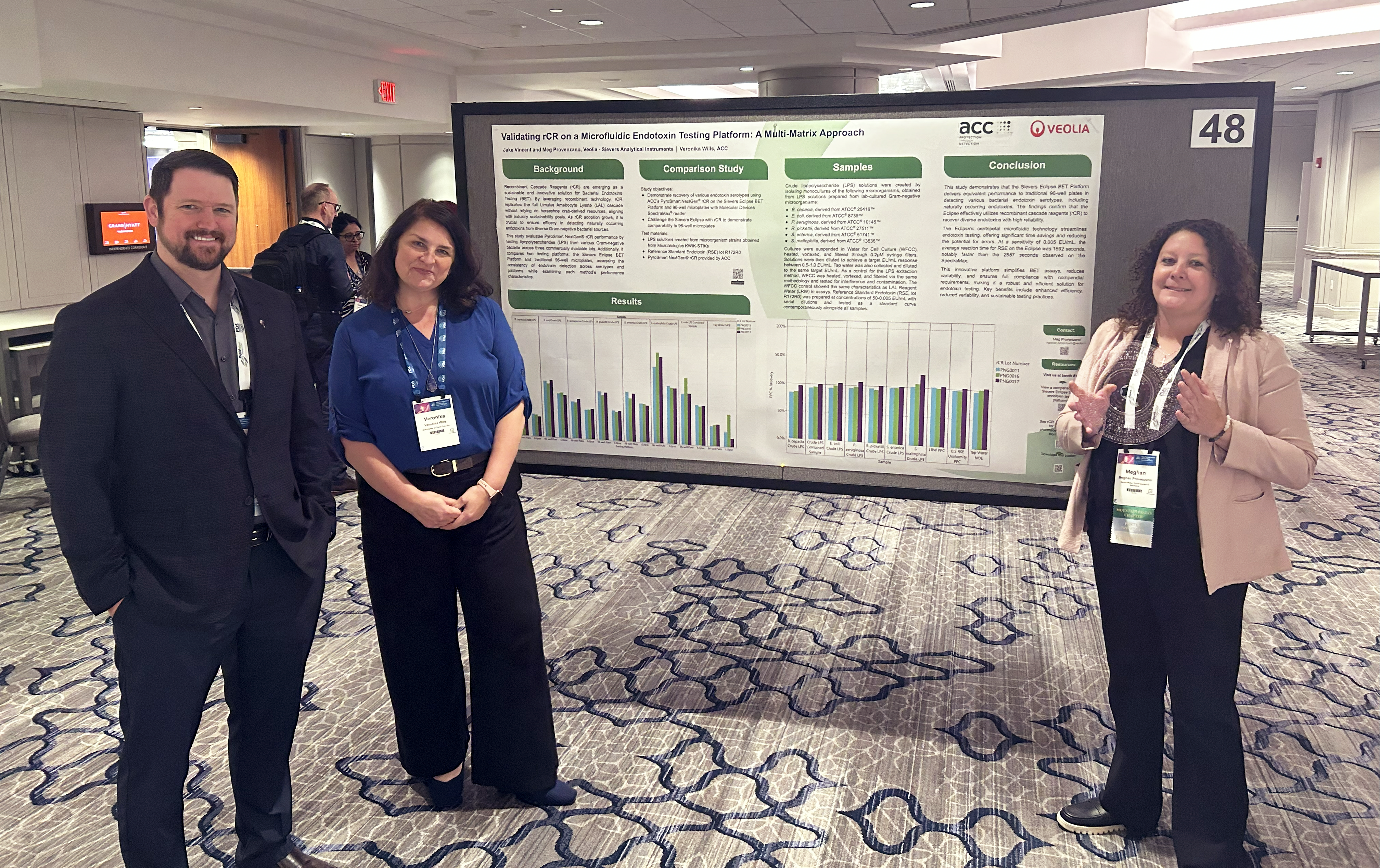
Nos résultats livrent des données de validation indispensables à l'appui de l'utilisation de la technologie des rCR avec une plateforme microfluidique avancée. Elles répondent en outre à des questions clés concernant la récupération des sérotypes, la comparabilité de la plateforme et les performances analytiques. Les résultats confirment que les réactifs recombinants en cascade permettent une récupération efficace et une fiabilité pour diverses endotoxines. Ceci confirme leur pertinence en tant qu'alternative de choix aux réactifs classiques à base de lysat d'amibocytes de limule (LAL) pour les tests d'endotoxines.
Contexte : technologie rCR et méthodes de détection des endotoxines
Les réactifs recombinants en cascade (rCR) constituent une alternative durable aux LAL classiques pour les tests d'endotoxines bactériennes. En tirant profit de la technologie recombinante, les rCR reproduisent l'ensemble de la cascade LAL, sans jamais dépendre des ressources dérivées de la limule. Ainsi, ils s'alignent sur les objectifs de durabilité du secteur. À mesure de l'adoption des rCR, une validation complète des endotoxines naturelles provenant de diverses sources bactériennes à Gram négatif devient de plus en plus indispensable.
Cette étude évalue la performance des rCR PyroSmart NextGen® sur les lipopolysaccharides (LPS) de plusieurs espèces bactériennes à Gram négatif. Trois lots commerciaux indépendants sont utilisés. En outre, l'étude compare deux plateformes de détection : la plateforme TEB Eclipse de Sievers et les microplaques classiques à 96 puits. Ceci a pour objectif d'évaluer la cohérence de la récupération des endotoxines entre les sérotypes et d'évaluer les caractéristiques de performance de chaque plateforme.
Conception de l'étude : comparaison des plateformes microfluidiques modernes avec les tests d'endotoxines bactériennes classiques
Objectifs de l'étude :
- Évaluer la récupération de divers sérotypes d'endotoxines à l'aide des rCR PyroSmart NextGen® d'ACC sur la plateforme TEB Eclipse de Sievers et sur des microplaques à 96 puits grâce au lecteur SpectraMax® de Molecular Devices.
- Évaluer la comparabilité de la plateforme entre les méthodes de détection microfluidique et les méthodes classiques de détection sur microplaques à 96 puits
- Caractériser les paramètres de performance sur plusieurs sources LPS
Matériel de l'essai :
- Solutions LPS créées à partir de souches de micro-organismes à Gram négatif (KWIK-STIK de Microbiologics)
- Endotoxine étalon de référence (RSE), lot R172R0
- PyroSmart NextGen® rCR (ACC)
Méthodes :
Des solutions brutes de lipopolysaccharides (LPS) ont été préparées à partir de monocultures de ces micro-organismes à Gram négatif :
- B. cepacia, dérivé de l'ATCC® 25416™
- E. coli, dérivé de l'ATCC® 8739™
- P. aeruginosa, dérivé de l'ATCC® 10145™
- R. pickettii, dérivé de l'ATCC® 27511™
- S. enterica, dérivé de l'ATCC® 51741™
- S. maltophilia, dérivé de l'ATCC® 13636™
Les cultures ont été suspendues dans de l'eau pour la culture cellulaire (WFCC), chauffées, agitées au vortex, puis filtrées à travers des filtres à seringue de 0,2 μM. Les solutions ont été diluées pour atteindre les réponses cibles de 0,5-1,0 UE/mL. L'eau du robinet a également été collectée et diluée à la même UE/mL cible.
Afin de contrôler la méthode d'extraction LPS, la WFCC a été chauffée, agitée au vortex et filtrée selon la même méthodologie. Elle a ensuite subi des tests pour détecter les interférences et la contamination. La WFCC témoin a démontré des caractéristiques de performance équivalentes à celles de l'eau réactive LAL (LRW) dans les essais.
L'endotoxine étalon de référence (RSE, lot R172R0) a été préparée dans une plage de concentration allant de 50 à 0,005 UE/mL par dilution en série. Elle a ensuite été testée sous forme de courbe standard, en même temps que tous les échantillons.
Résultats et conclusions :
Équivalence de la plateforme TEB et caractéristiques de performance des rCR
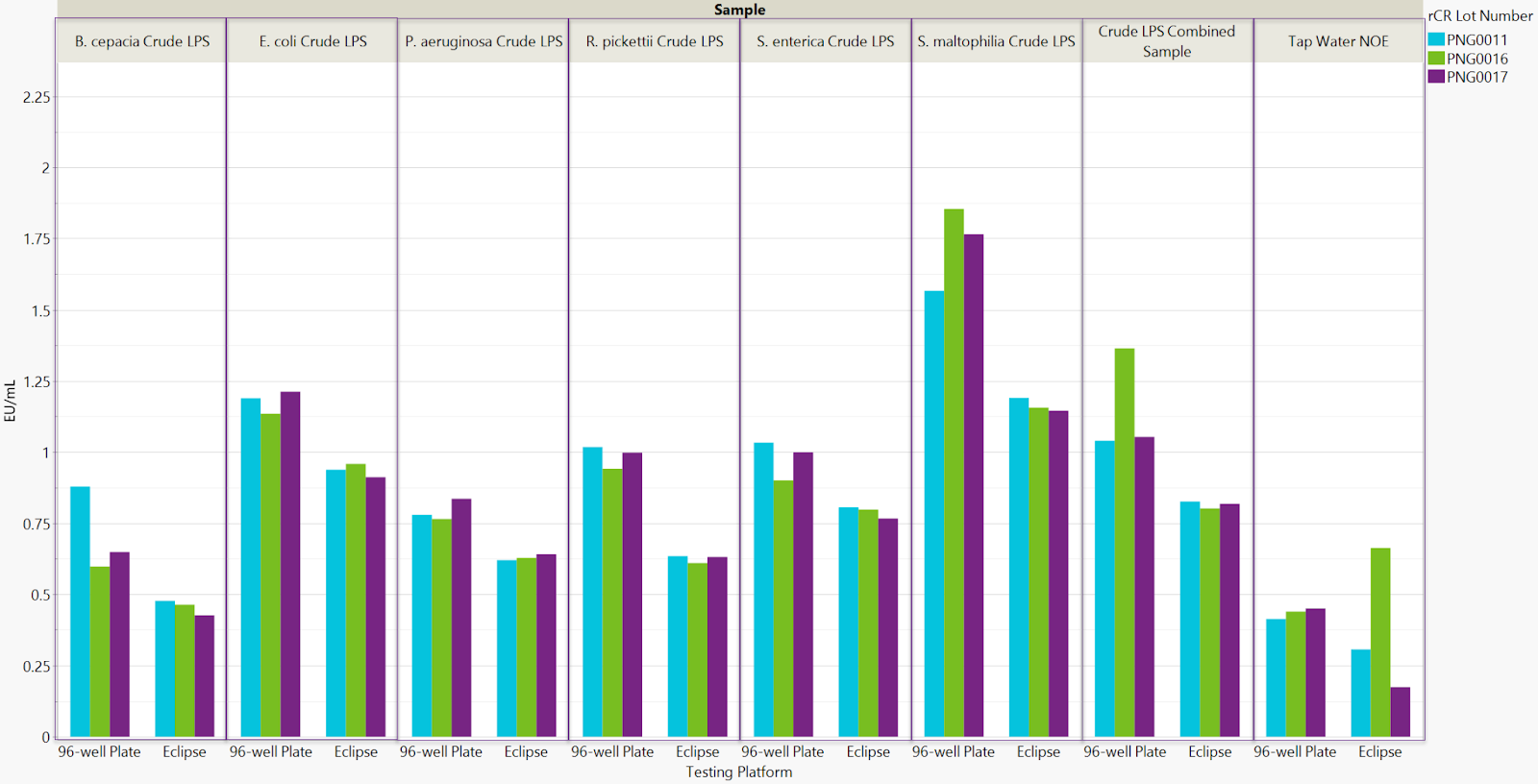
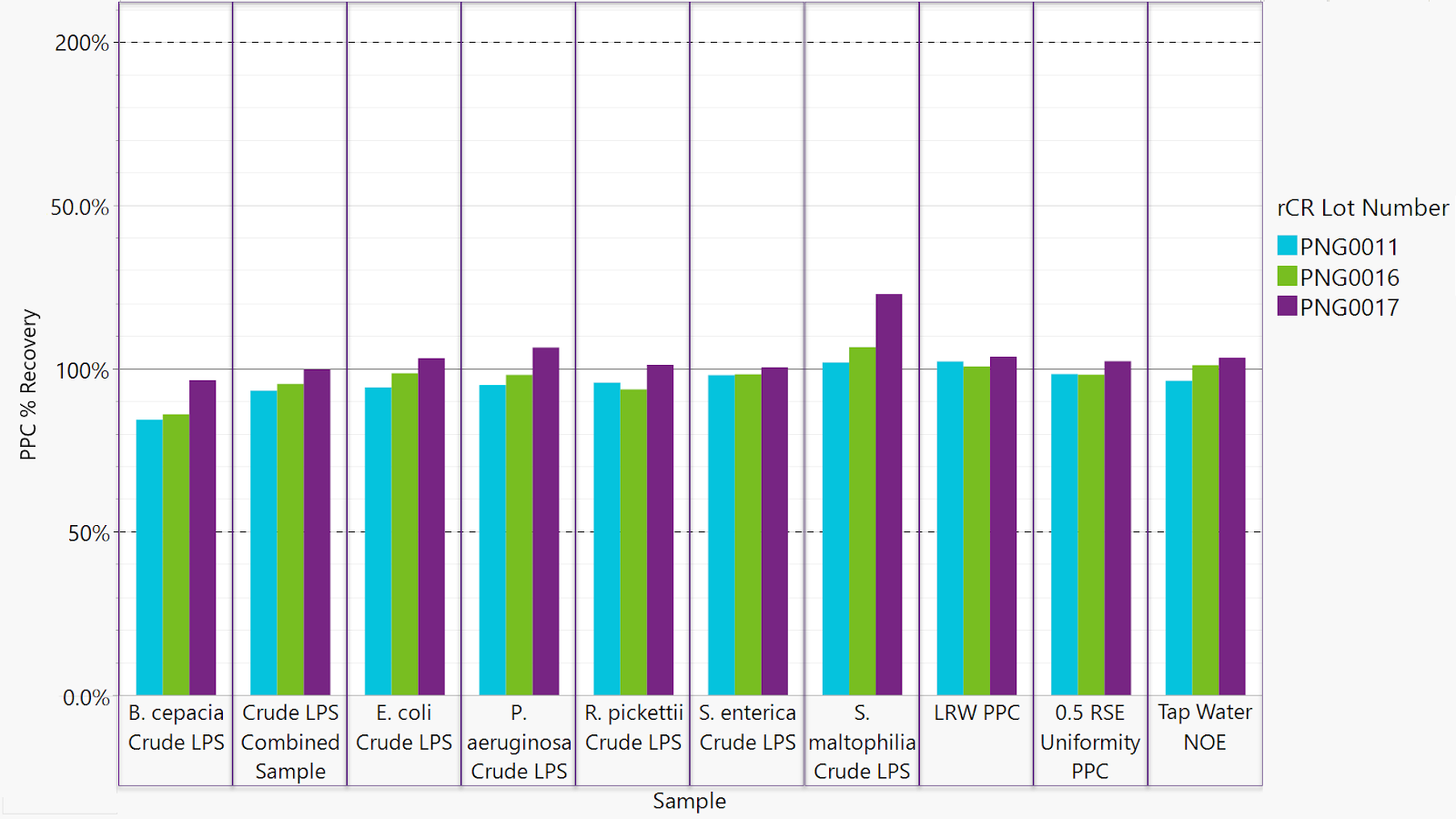
Cette étude confirme des performances équivalentes entre la plateforme TEB Eclipse de Sievers et la méthodologie classique des plaques à 96 puits pour détecter divers sérotypes d'endotoxines bactériennes, y compris les endotoxines naturelles. Les données valident l'efficacité des réactifs recombinants en cascade (rCR) par la plateforme Eclipse pour une récupération fiable à travers diverses endotoxines.
La technologie microfluidique centripète d'Eclipse offre des avantages opérationnels, notamment un temps d'analyse moindre et un risque d’erreur plus faible. À une sensibilité de 0,005 UE/mL, le temps de réaction moyen pour la RSE sur Eclipse a été de 1,692 secondes. Ceci représente une réduction de 37 % par rapport aux 2,687 secondes observées avec SpectraMax.
Les principales conclusions confirment que la plateforme Eclipse est une solution conforme pour les tests d'endotoxines, offrant :
- Une meilleure efficacité analytique avec un gain de temps significatif
- Une variabilité moindre grâce au traitement microfluidique automatisé
- Des pratiques de test durables grâce à la compatibilité rCR
- Un maintien de la sensibilité et de la précision de diverses sources d'endotoxines
Ces résultats contribuent au nombre croissant de preuves soutenant l'adoption des rCR et des plateformes microfluidiques avancées pour les applications de contrôle de la qualité pharmaceutique.
En savoir plus sur le Sievers Eclipse
Auteurs :
- Veronika Wills
-
Veronika Wills dirige les groupes Global Technical Service de l'Associates of Cape Cod, Inc. Elle a rejoint l'équipe en 2007 ans. Depuis, elle est devenue une experte en la matière et une conférencière de renommée mondiale sur les tests d'endotoxines et de glucanes. Sa grande expertise est vitale pour les clients d'ACC lorsqu'il s'agit d'assistance technique concernant les tests des matrices d'échantillons complexes, la résolution des problèmes, la validation des méthodes, les enquêtes et les aspects réglementaires des TEB. Plus récemment, Veronika a été très impliquée dans l'évaluation et la mise en œuvre des technologies recombinantes et leur automatisation. Veronika est titulaire d'un Master en génie biochimique de l'Institut de technologie chimique de Prague, en Tchéquie.
- Meg Provenzano
-
Meg Provenzano est responsable de produit à l'international pour les instruments d'endotoxine Sievers chez Veolia. Elle possède plus de 10 ans d'expérience dans le secteur des tests d'endotoxines bactériennes et a occupé plusieurs postes liés au contrôle de la qualité, à l'assistance technique et à la gestion des produits. Avant de rejoindre Veolia, Meg était chef de produit chez Charles River Laboratories. Elle est attentive aux besoins des clients et aime résoudre les problèmes sur le terrain, qu’il s’agisse de questions techniques, d’aide à l’analyse ou de logiciels. Meg est titulaire d'une licence en sciences et biologie marines de l'université de Coastal Carolina, où elle s'est spécialisée sur la recherche concernant les populations de dauphins.
- Jake Vincent
-
Jake Vincent est spécialiste de la biodétection et le chercheur principal expérimenté du groupe de recherche et développement Sievers de Veolia. Il travaille notamment au développement d'instruments analytiques de biodétection. Son rôle dans le développement de l'analyseur d'endotoxines Eclipse de Sievers fut déterminant. Jake était responsable de la conception des étalons pré-déposés et intégrés dans le consommable microfluidique. Les recherches de Jake sur la détection des endotoxines microfluidiques, « Miniaturization, Parallelization, and Automation of Endotoxin Detection by Centrifugal Microfluidics », ont été co-écrites et publiées dans Analytical Chemistry. Avant de rejoindre Veolia, Jake a travaillé au développement de méthodes analytiques pour les tests de vaccins contre le flavivirus chez Inviragen et Takeda Vaccines, notamment les essais cliniques du vaccin contre la dengue, Qdenga. Il est titulaire d'un B.S. de l'Université d'État du Colorado.